



What Is White Label Analytics? (And Why Most SaaS Platforms Get It Wrong)
White label analytics allows SaaS products to embed dashboards and insights under their own brand, fully integrated into the application. Users interact with data inside the same interface, which improves adoption and keeps workflows uninterrupted. The key difference from basic embedding lies in integration depth. iFrame-based approaches limit customization and create disconnected experiences, while SDK and API-based platforms enable deeper control, better performance, and scalability across tenants. For SaaS teams, this affects retention, monetization, and development speed, turning analytics into a core product capability rather than an external add-on.
 Casey Ciniello
21min read
Casey Ciniello
21min read
 ChatGPT
 Perplexity
Executive Summary:
White label analytics allows SaaS products to embed dashboards and insights under their own brand, fully integrated into the application. Users interact with data inside the same interface, which improves adoption and keeps workflows uninterrupted. The key difference from basic embedding lies in integration depth. iFrame-based approaches limit customization and create disconnected experiences, while SDK and API-based platforms enable deeper control, better performance, and scalability across tenants. For SaaS teams, this affects retention, monetization, and development speed, turning analytics into a core product capability rather than an external add-on.
Key Takeaways:
- White label analytics keeps users inside your product
- Integration depth defines how analytics fits your workflows
- iFrame-based tools limit customization and flexibility
- Analytics increases retention and product value
- Scalability and multi-tenancy are essential for SaaS
- Building analytics adds long-term cost and complexity
Here’s how it usually goes. A SaaS product team decides they need analytics inside their product. They evaluate a few platforms, see demo dashboards that look clean and branded, and pick the one that checks the white label box. Integration happens. The dashboards go live.
Then the design team asks why the analytics section doesn’t quite match the rest of the product. Or a customer notices the modal window has different fonts. Or someone asks whether the AI assistant can be renamed and reskinned, and the answer is no, that’s the vendor’s interface, not yours.
This is the moment most teams realize that ‘we support white labeling’ and ‘your customers will never know this isn’t yours’ are two completely different claims. Most platforms deliver the first. Very few deliver the second. The gap between them is architectural, not cosmetic, and understanding it before you commit to a platform is the most important evaluation you’ll do.
What is White Label Analytics?
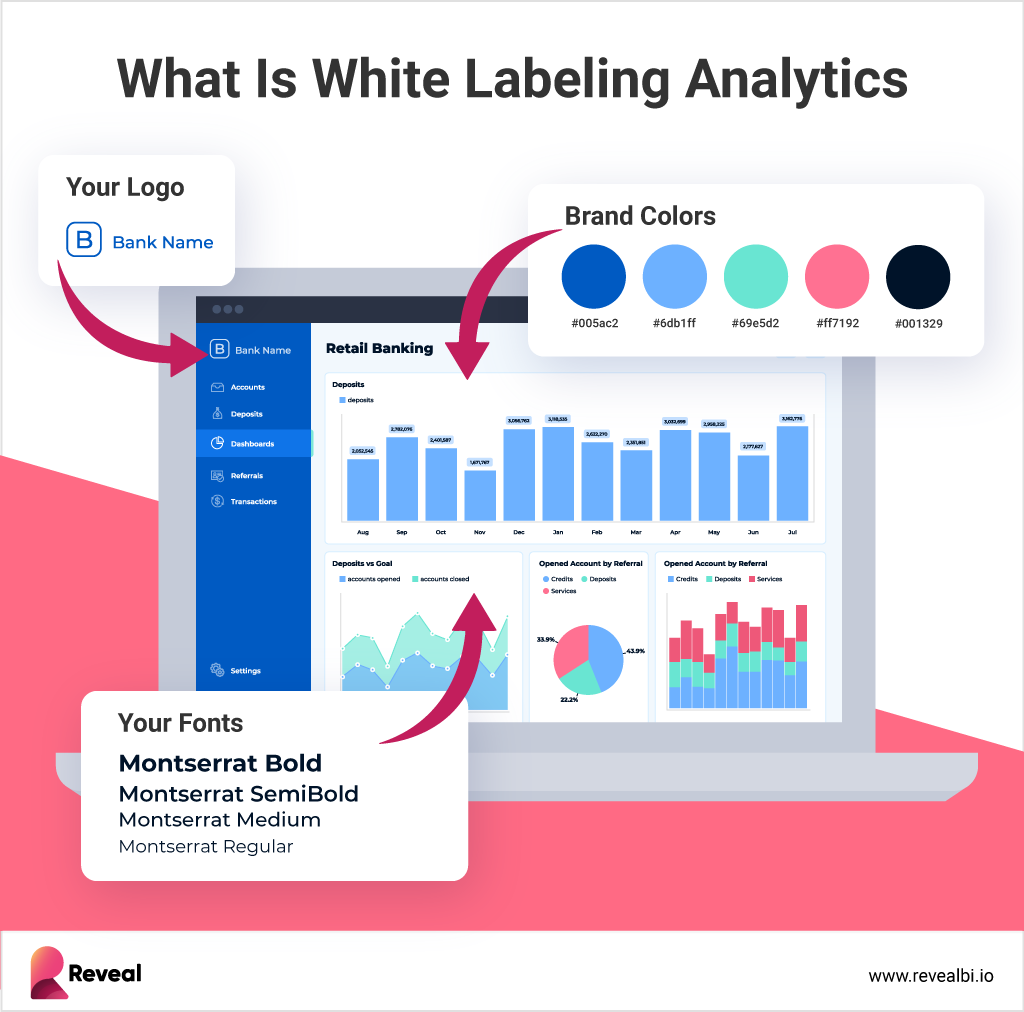
White label analytics is the embedding of fully branded analytics capabilities, often delivered as embedded analytics, such as dashboards, reports, data visualizations, and AI-powered insights, inside a software product, where the host application’s brand governs every element of the experience. Users interact with analytics inside the product and see only that product’s brand. The underlying analytics vendor is invisible.
The key phrase is ‘every element of the experience.’ Not just the logo. Not just the color scheme. Every component, every interaction, every AI response, every domain reference, all of it reflecting the host product’s identity rather than the analytics vendor’s.
That level of control requires a different architectural approach than what most platforms provide. Which is where the evaluation gets interesting.
The White Label Misconception That Cost Teams Months
The most common mistake teams make when evaluating white label analytics is treating it as a branding exercise rather than an architectural one. You upload a logo. You pick your primary color. You maybe add a custom domain if the tier allows it. The dashboards look roughly right in the demo. You ship.
The problems emerge over time, in specific moments:
- The first customization request beyond colors. A designer wants to change how a specific chart component behaves on hover. Or the filter panel animation doesn’t match the rest of the product. These changes are inside the analytics interface, and if that interface is loaded via iFrame, you don’t control what’s inside it. Only what’s around it.
- The AI assistant. Your product is adding AI features. The analytics platform has an AI assistant too, but it operates as a separate layer instead of a unified AI analytics experience, with its own interface, its own modal style, and its own branding.
- Your customers see two AI experiences that look nothing alike. One feels native. One doesn’t.
- The enterprise customer. A new customer has strict brand requirements. Every screen of your product, including analytics, needs to carry their brand, not yours. Per-tenant theming means each customer sees their own brand in the analytics layer. If the platform doesn’t support this architecturally, you’re maintaining workarounds.
- The pricing conversation at scale. You’ve driven strong analytics adoption. More customers are using the analytics features more frequently. Then you see the invoice. Usage-based pricing with a white label platform that succeeded is more expensive than one that didn’t.
None of these are edge cases. They are the normal evolution of any SaaS product that treats analytics as a serious feature. And they all trace back to the same root cause: choosing a platform based on how it looks in a demo rather than how it’s built.
What Genuine White Label Analytics Requires
True white label analytics has two distinct requirements that need to be satisfied simultaneously: complete brand control and architectural integration. Most platforms deliver partial versions of each.
What complete brand control it means in practice
Complete brand control means the analytics experience is indistinguishable from the rest of your product. Not just similar, indistinguishable, Not just similar, indistinguishable, which depends on having full control over core embedded analytics features rather than relying on surface-level theming. That requires:
- Design system inheritance, not override. The analytics layer should render using your design system, your fonts, your spacing, your interaction states, your hover behaviors, not a theme applied on top of the vendor’s default styles. When analytics inherits your design system through analytics SDK integration, it behaves like it was built by your team. When CSS is applied to an iFrame, it approximates your brand within the constraints of the vendor’s interface.
- Component-level control. Every chart type, filter element, tooltip, and interaction pattern should be configurable. Not just the color. The behavior.
- AI that carries your brand. In 2026, analytics platforms have AI assistants. If that AI assistant has a different visual identity from the rest of your product, its own modal, its own fonts, its own interaction model, it breaks the white label experience at the most visible layer.
- Your domain, always. White label analytics should be served from your domain. Not a subdomain of the vendor’s platform. Not a redirect. Your URL, consistently.
Architectural integration determines everything else
The architectural question is: how does the analytics layer connect to your application, and how it interacts with underlying data sources without breaking your application’s data model?
iFrame embedding loads an external interface inside a container in your application. You control the container — size, position, what’s around it. You do not control what’s inside it.SDK integration puts analytics inside your application’s component tree. Your application governs the rendering, the behavior, and the visual output. The analytics layer inherits your context rather than imposing its own.
This distinction determines the ceiling of what’s possible. iFrame-based white labeling has a ceiling, there are things you simply cannot change about how the analytics renders because you don’t control the rendering. SDK-based white labeling doesn’t have that ceiling. If your design system defines it, the analytics layer can implement it.
The practical test: ask the platform whether you can change how a specific chart component behaves on hover. Not the color, the behavior. If the answer requires a workaround or isn’t possible, you’re hitting the iFrame ceiling.
How White Label Analytics Works – The Five Key Layers
White label analytics operates across five interconnected layers. Understanding each layer clarifies why some platforms can promise complete white labeling and others can’t, the answer is usually in which layers are genuinely exposed to the host application.
- The branding layer
Controls every visual element users see: colors, fonts, layouts, component behavior, logo, and domain. In SDK implementations, the branding layer is defined by the host application’s design system. In iFrame implementations, it’s constrained to whatever CSS overrides the vendor allows.
- The embedding layer
Determines how analytics connects to the application architecture. SDK embedding integrates into the component tree —full control, no ceiling. iFrame embedding loads an external interface in a container, limited control, clear ceiling.
- The data and multi-tenancy layer
Manages how data is retrieved and isolated per tenant, which is a core requirement in architectures like multi-tenancy data in embedded analytics.. In a well-designed system, each tenant’s data is isolated at the query level, before any data is returned, not filtered in the UI after the fact. Per-tenant theming (serving different brand identities to different customers) requires the branding and multi-tenancy layers to work together at the SDK level.
- The security layer
Controls authentication, permissions, and data access across the entire embedded analytics security model. The key question: does your authentication model govern the analytics layer, or does the analytics platform require a separate identity system? White label analytics should inherit your existing auth, SSO, JWT, token-based, with no Reveal login prompt visible to your customers. - The AI layer
Modern platforms include conversational analytics, users ask questions, get answers. For white label deployments, the AI layer must be governed by the same security and tenancy architecture as everything else. AI queries need to be scoped to the user’s tenant and role. The AI interface needs to carry the host application’s brand. Token costs need to be controlled. Platforms that bolt AI onto an existing analytics layer typically address these as afterthoughts, platforms built API-first handle them structurally.
White Label Analytics Examples Across Industries
White label analytics appears wherever a SaaS product needs customers to interact with data inside the product rather than in a separate tool, as seen across common embedded analytics examples. The architectural requirements are the same across industries. What changes is why brand consistency matters so much in each context.
| Industry | What they embed | Why white labeling matters |
|---|---|---|
| SaaS platforms | Usage metrics, feature adoption, customer KPIs | Customers expect analytics to feel like part of the product, a visible third-party tool breaks that trust |
| Fintech | Transaction data, portfolio performance, risk reporting | Brand consistency directly affects user trust in financial data, any inconsistency raises doubt |
| Healthcare | Patient outcomes, operational metrics, clinical reporting | Strict workflows mean any context switch or visual inconsistency creates compliance risk |
| Marketing platforms | Campaign performance, attribution, audience insights | Clients pay for insights, if the analytics looks like a separate tool, the platform’s value proposition weakens |
| Logistics | Shipment tracking, warehouse performance, operational dashboards | Real-time visibility is the core product value, it must behave natively |
| ISV / OEM | Full analytics layer under their own brand for end customers | The entire product is white-labeled — analytics cannot be the one element that breaks the illusion |
Where Teams Go Wrong — The Five Failure Patterns
Most white label analytics failures don’t happen at the initial integration. They happen 6–18 months later, when the product evolves and the platform’s architectural limitations become constraints.
Choosing iFrame embedding for the speed, paying for it later
iFrame embedding ships fast. The first version looks fine. Then the product evolves, new design system, new interaction patterns, AI features that need to integrate with the analytics layer, and each iteration requires a workaround because the iFrame doesn’t expose what the application needs to change. The technical debt accumulates until a replatform is the only realistic option.
Treating white labeling as a tier upgrade rather than an architecture
Some platforms charge for white labeling, t’s a feature you unlock at a higher price point. Others have white labeling enabled by default because it’s architectural: the SDK always integrates at the component level, so the host application always governs the rendering. The distinction matters because a platform where white labeling is a settings toggle can usually also toggle it off or has vendor branding visible in places the settings menu doesn’t cover.
Ignoring multi-tenancy until it becomes a problem
For SaaS products serving a single customer segment, multi-tenancy seems theoretical early on. Then the enterprise segment comes. Each enterprise customer wants analytics that carries their branding, not the SaaS vendor’s. If the platform doesn’t support per-tenant theming and per-tenant data isolation through the same architecture, you’re now maintaining separate deployments or complex custom configurations per customer.
Not modeling pricing at 3x and 10x current usage
A usage-based pricing model that looks affordable at 500 users with moderate engagement looks very different at 5,000 users with strong analytics adoption. The perverse dynamic: the better your white label analytics performs, the more users engage with it, the higher the cost. Fixed pricing removes this dynamic. Evaluate pricing at your target scale, not your current scale.
Treating AI as a feature rather than a governance question
Adding AI to a white label analytics deployment introduces risks that static dashboards don’t have: tenant data leakage if AI queries aren’t properly scoped, unpredictable token costs if usage isn’t governed, AI responses that carry the vendor’s visual identity rather than the host product’s. Evaluate AI governance before evaluating AI features.

Build vs. Buy: The Real Decision Most Teams Face
The build vs. buy question for white label analytics comes up in almost every SaaS product team’s planning cycle. The honest answer depends less on technical capability and more on where you want your engineering team’s attention for the next 18 months.
| Build in-house | Buy a white label platform | |
|---|---|---|
| Time to first dashboard | 3–6 months minimum | 1–2 weeks |
| Multi-tenancy | Build from scratch | Supported by architecture |
| White-label UI control | Complete — but you maintain it | Complete — platform maintains it |
| AI capabilities | Build or bolt on separately | Embedded in the same layer |
| Ongoing maintenance | Your team, indefinitely | Platform updates automatically |
| Upfront cost | High (engineering time) | Lower (platform fee) |
| Long-term cost | Grows with product complexity | Predictable, fixed or usage-based |
| When it makes sense | Highly unique requirements | Most SaaS products |
The teams that choose to build usually have genuinely unique requirements, an analytics experience so specific to their product’s domain that no existing platform can accommodate it. These teams exist, but they’re the exception.
The teams that end up regretting building typically underestimated one of three things: the complexity of multi-tenancy at the query level, the ongoing maintenance burden of a visualization layer, or the engineering cost of adding AI capabilities to a custom-built system.
These three things together represent a significant and sustained engineering investment — one that grows as the product scales and as AI capabilities become expected.
The practical test: if you removed your analytics investment from your engineering roadmap, what would your team ship instead? If the answer is features that differentiate your core product, the build vs buy math usually favors buying.
How to Evaluate a White Label Analytics Platform
The criteria that separate good white label analytics platforms from limiting ones are mostly invisible in demos. These are the questions that expose architectural limitations before you commit.
Can you change component-level behavior, not just colors?
Ask specifically: can we change how this chart type behaves on hover? Can we change the filter panel’s interaction model? Can we integrate the analytics layer with our application’s existing navigation patterns? If the answer requires workarounds or isn’t possible, the platform is iFrame-based at its core and will hit a ceiling as your product evolves.
How is tenant isolation enforced?
Ask for a technical explanation, not a feature bullet. If the answer is ‘we filter the dashboard based on the user’s tenant,’ that’s UI-level isolation, a security risk that can be circumvented. If the answer is ‘tenant context is applied at the query layer before any data is returned,’ that’s architectural isolation. The difference matters for compliance, security, and the enterprise sales conversation.
Where is the vendor’s branding in the default state?
Install the platform in a test environment and look for vendor branding without changing any settings. In a genuinely white-labeled platform, the default state has no visible vendor identity. If you find vendor branding anywhere, in AI interfaces, in onboarding flows, in error states, that’s what your customers will see unless you specifically configure it away.
What does the pricing look like at 10x current usage?
Get a specific number. Not a range, not “it depends on your contract,” a number based on your actual expected user count and engagement patterns at scale. Then decide whether that number works for your business model. Usage-based pricing that’s affordable at your current scale can become a significant cost center as your product succeeds.
How does the AI layer integrate with your brand and governance model?
Ask what the AI assistant looks like to your users, specifically, whether it uses the vendor’s visual identity or yours. Ask how AI queries are scoped in a multi-tenant environment. Ask whether token costs are controlled at the platform level or exposed to user behavior. If any of these answers are unclear, the AI feature isn’t production-ready for a white label deployment.
Where to Go From Here
White label analytics done right, SDK-native, design-system-aware, multi-tenant at the query level, AI under your brand, is one of the strongest product investments a SaaS company can make. Analytics that looks and behaves like it was built by your team drives adoption, improves retention, and creates upsell opportunities that bolted-on dashboards don’t.
White label analytics done wrong with CSS theming on an iFrame, UI-level multi-tenancy, vendor branding that resurfaces in AI features, creates technical debt that compounds as your product scales. The evaluation questions in this guide are designed to surface the difference before you commit, not after.
Frequently Asked Questions
What’s the difference between white label analytics and embedded analytics?
Embedded analytics is about where analytics lives — integrated into an application rather than in a separate tool. White label analytics is about how it looks and behaves — under the host application’s brand rather than the vendor’s. A product can embed analytics without fully white labeling it (visible vendor branding, limited UI control). True white label analytics requires both: native integration at the SDK level and complete brand control at every layer of the experience.
Why do most white label analytics tools fall short?
Most platforms use iFrame-based embedding, which loads an external interface inside a container. You can style the container, change colors, and swap logos, but you can’t control the interface itself. Component behavior, interaction patterns, and AI interfaces all remain the vendor’s. SDK-based platforms integrate into your application’s component tree, which means your application governs the rendering. The difference is the ceiling: iFrame embedding has one. SDK integration doesn’t.
What is the difference between white-label BI and white label analytics?
White-label BI (business intelligence) typically refers to traditional BI tools — reporting platforms, data visualization tools — rebranded for resale or embedded use. White label analytics in the modern SaaS context is a broader category that includes embedded dashboards, real-time data experiences, self-service analytics, and AI-powered insights, all delivered under the host product’s brand and integrated at the SDK level. The distinction matters because traditional BI tools weren’t designed for the product integration requirements of modern SaaS.
Can white label analytics be monetized?
Yes, and it’s one of the stronger business cases for investing in it. Analytics features can be positioned as premium tier offerings, creating natural upsell opportunities. For ISVs and OEM vendors, fully white-labeled analytics can be packaged and sold to end customers as part of a branded product offering, creating new revenue streams. The key is that the analytics experience must feel native to justify premium pricing. Bolted-on dashboards don’t create the same perceived value.
What is per-tenant theming and why does it matter?
Per-tenant theming means each customer sees the analytics layer branded to their own identity rather than the SaaS vendor’s. It’s the capability that enables enterprise customers to have analytics that carries their corporate brand inside the SaaS product they’re using. It requires the platform to apply different brand configurations per customer from the same deployment without separate environments. For ISVs serving enterprise clients, per-tenant theming is often a contract requirement, not a nice-to-have.
How is white label analytics different from custom-built analytics?
Custom-built analytics gives you complete control over every element but requires your engineering team to build and maintain every layer: data pipelines, query engines, visualization components, multi-tenancy, security, and now AI. White label analytics platforms provide that infrastructure as a managed layer, leaving your team to configure and integrate rather than build from scratch. The tradeoff is building time and maintenance burden versus flexibility at the edges. For most SaaS products, the time and cost of building from scratch outweighs the marginal flexibility benefit.