



 Return to Blog
Vibe Coding Analytics: Can You Really Build Instead of Buy?
Vibe coding analytics is changing how SaaS teams approach build vs buy decisions. AI makes it easy to generate dashboards, test ideas, and move fast early. But speed at the start does not translate to success in production. Customer-facing analytics requires governance, security, and cost control—areas where AI alone falls short. As AI raises expectations from dashboards to embedded intelligence, teams must decide to build and own the complexity, or adopt a platform designed for production analytics.
 Zdravko Kolev
11min read
Zdravko Kolev
11min read
 ChatGPT
 Perplexity
Executive Summary:
Vibe coding analytics is changing how SaaS teams approach build vs buy decisions. AI makes it easy to generate dashboards, test ideas, and move fast early. But speed at the start does not translate to success in production. Customer-facing analytics requires governance, security, and cost control—areas where AI alone falls short. As AI raises expectations from dashboards to embedded intelligence, teams must decide to build and own the complexity, or adopt a platform designed for production analytics.
Key Takeaways:
- Vibe coding analytics speeds up development, but does not solve production complexity.
- Early success in demos does not translate to real-world performance.
- Customer-facing analytics requires scalability, security, and product-level UX.
- The last 20–30% of analytics development is the hardest to deliver.
- Building analytics introduces long-term maintenance and infrastructure costs.
- Buying is often the more practical choice for SaaS products.
Vibe coding analytics now comes up in almost every sales conversation. Prospects see a demo, run a quick POC, and assume they can build it themselves with AI. On paper, this looks like a cost-conscious decision. In practice, it often ignores the trade-offs that come with AI-built analytics in a product.
Vibe coding analytics lets teams generate dashboards using natural language instead of manual coding. Developers can prompt AI to create queries and visualizations in seconds.
This shift changes how analytics gets built and how teams think about ownership.
SaaS product teams often focus on low upfront cost and fast deployment. These benefits are real, but they come from controlled scenarios. Most assumptions form in demos, not in production environments where systems must scale and perform.
The real question is not how fast you can generate dashboards.
It is how well you can support analytics inside your product over time. Performance, security, scalability, and user experience all matter. This is where the gap starts to show.
The Rise of Vibe Coding in Analytics
Analytics workflows have changed. Tasks that once required SQL, data modeling, and manual setup now happen through prompts. Teams can move from question to output without building the layers in between. This reduces the friction of working with data.
The experience feels immediate. A user describes a metric or trend and gets a working result. In many cases, that result is good enough for exploration or early decisions. This is why AI-generated dashboards are gaining traction.
For early use cases, this works.
This shift also changes how organizations approach analytics. Many now treat AI analytics as a core capability instead of a separate layer. Teams define outcomes and expect systems to handle execution.
But expectations are starting to drift from reality.
Product owners assume analytics can be built quickly and with minimal effort through vibe coding. This holds in controlled scenarios.
When moved into real-world environments, vibe coding analytics struggles to meet production requirements.
Why SaaS Teams Believe They Can Build It
The belief does not come from inexperience. It comes from real progress in how software gets built. AI tools now produce working outputs in seconds. For many use cases, those outputs are usable.
This is where vibe coding analytics reinforces that confidence. Teams see results appear instantly and assume the system behind them is just as simple. The gap between idea and execution appears small.
Three main factors boost this false confidence.
- Strong engineering teams
They already manage complex systems and expect analytics to follow similar patterns. - Rapid improvement in AI tools
Capabilities improve quickly, which increases confidence in what can be built internally. - Immediate, visible results
Dashboards and queries appear instantly, which makes the solution feel complete.
This creates a misleading signal. AI shows what the end result looks like, but not how it operates behind the scenes. The complexity remains hidden until the system needs to handle real users, real data, and real constraints.
The conclusion feels justified. It is based on visible evidence. But it does not account for what happens after the initial build.
Internal Tool vs. Customer-Facing Analytics
Most teams start with internal analytics. They build dashboards for their own use, test ideas, and iterate quickly. In this context, vibe coding analytics often works well. The scope is limited, and the risks are low.
The shift happens when analytics becomes part of the product. This is where embedded analytics comes into play. Instead of supporting internal decisions, analytics now serves external users with different expectations and requirements.
| Internal Analytics | Customer-Facing Analytics |
|---|---|
| Single-use case | Multiple use cases |
| Limited users | External customers |
| Flexible UX | Product-grade UX |
| No branding requirements | Full integration and consistency |
| Low risk | Business-critical |
The difference is not incremental. Internal tools tolerate gaps and inconsistencies. Product analytics must handle scale, performance, and user expectations from day one. What works for internal teams often breaks when exposed to customers.
This is where many build efforts stall. The challenge is no longer generating dashboards. It is delivering a reliable, consistent experience inside a product.
What It Actually Takes to Build Analytics That Customers Love
Generating dashboards is only one part of the problem. Building analytics for a product requires systems that support scale, users, and long-term use. This is where vibe coding analytics starts to fall short. It produces outputs, but it does not account for everything behind them.
Feature Complexity
Production analytics depends on multiple layers working together. Data must be pulled from multiple sources, normalized, and served with consistent performance across tenants without leaking data between customers. Teams must manage connections to multiple data sources, handle caching, and support real-time queries. Filtering, drill-down, and multi-tenant logic must all work without breaking the experience.
Product Fit and Customization
Analytics must feel like part of the product, not an add-on. Every element should match the host application in design and behavior. This includes layout, interactions, and consistency across different environments. Many teams underestimate how much work goes into white-label analytics that align with their product.
AI Expectations
Users now expect more than static dashboards. They want to ask questions and get answers instantly. This includes natural language querying, insight generation, and context-aware recommendations. Building these capabilities requires more than integrating a model. It requires systems that understand the data and respond consistently.
Security and Deployment
Analytics systems must protect data and respect user boundaries. Embedded analytics security includes strict tenant isolation, access control, and safe handling of sensitive information. Many teams must also support on-prem analytics or controlled environments where data cannot leave the system.
All of these elements must work together. This is what turns analytics from a feature into a product capability. It is also where building analytics becomes a long-term responsibility rather than a one-time effort.
The Hidden Costs of Building Analytics with AI
The initial investment in vibe coding analytics appears low. The real cost emerges as the system grows and moves into production.
- Opportunity Cost
Development effort shifts away from the core product. Teams spend time building analytics instead of improving their main offering. This trade-off slows down innovation in areas that drive revenue. - Maintenance Cost
Generated code still needs ownership. Systems require updates, bug fixes, and continuous improvements. As vibe coding analytics expands, maintaining consistency across features becomes more demanding. - Infrastructure Cost
Analytics systems depend on data pipelines, query performance tuning, storage, and compute resources. AI adds another layer of cost through model usage and processing. Many teams overlook how the AI token cost affects long-term scalability. These costs increase as usage grows. - Security Cost
Protecting data requires ongoing investment. Teams must enforce access control, prevent leakage, and meet compliance standards. These responsibilities increase with each new user and dataset. - Architectural Oversight
Building analytics requires senior engineering involvement to design for scalability, maintainability, and reliability. Systems must remain scalable, maintainable, and reliable. As requirements evolve, teams must also plan for scalable analytics. This is where vibe coding analytics often reaches its limits.
These costs do not appear during early development. They surface as the system grows and usage increases. What starts as a simple build can turn into a long-term operational burden.
The 70–80% Problem of Vibe Coding
Most builds follow the same pattern. Teams move fast at the beginning and generate working outputs in a short time. Early results create momentum and confidence. Progress feels steady and predictable.
The first 70–80% is the easy part.
It includes what AI does best. Teams generate dashboards, queries, and basic workflows with minimal effort. These outputs cover common use cases and simple scenarios. This is where vibe coding analytics delivers clear value.
The remaining 20–30% is where the real work begins. Systems must handle:
- edge cases
- large datasets
- inconsistent inputs
User experience must stay consistent across different environments. Integrations must work reliably with existing systems and workflows.
This is where most builds start to struggle.
Progress slows down. What looked complete at first reveals gaps that require deeper engineering. Many teams can reach the first stage. Fewer can take vibe coding analytics all the way to production readiness.
Where Vibe Coding Analytics Works, and Where It Breaks
Vibe coding analytics works well in controlled scenarios. It struggles when requirements expand beyond simple use cases. The difference comes down to context, not capability.
Where It Works
- Internal dashboards
Teams explore data without strict requirements or external expectations. - Prototyping analytics features
Product teams test ideas quickly before committing to a full build. - Simple reporting use cases
Limited users, predictable queries, and low variation in data. - Data exploration tools
Analysts interact with data without needing production-level stability.
Where It Breaks
- SaaS products with external users
Different customers expect fast, consistent performance and reliable results. Systems often degrade under load, leading to slow dashboards and inconsistent query results. - Multi-tenant environments
Systems must isolate data while maintaining speed and stability. - Regulated industries
Security, compliance, and data control add strict requirements. - Long-term product strategy
Analytics must evolve with the product and remain maintainable. - Maintainability over time
AI-generated systems become harder to update, debug, and scale. Small changes can break dependent queries and workflows, increasing long-term engineering effort.
Build vs Buy in the Age of AI: A Better Framework
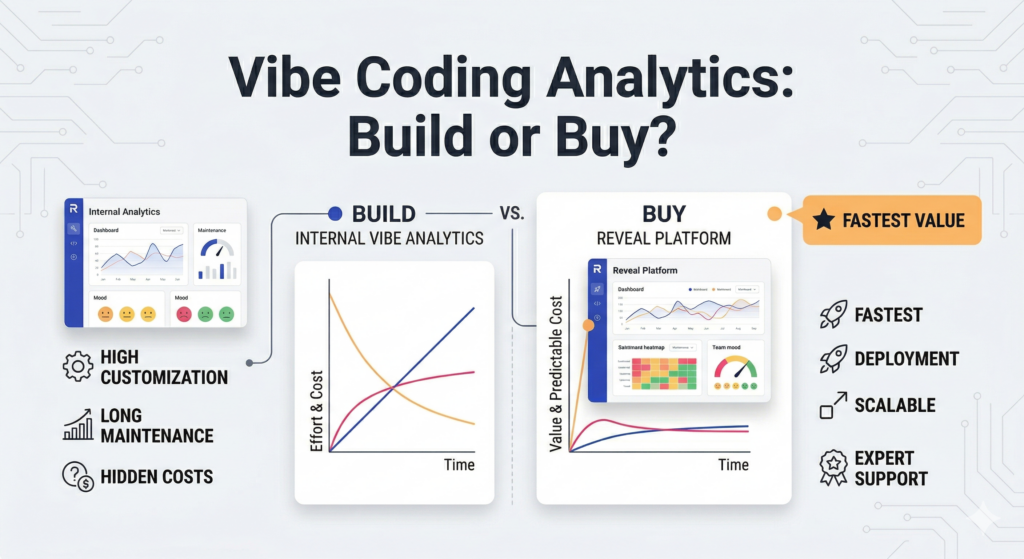
You can decide whether to build or buy analytics by answering a few direct questions. The goal is to understand what you are committing to over time. Vibe coding analytics makes building easier, but it does not reduce long-term responsibility.
Teams that want a deeper breakdown of this decision can explore this guide on buy or build analytics. The core idea remains simple. Ownership requires ongoing investment in people, systems, and infrastructure.
| Question | Build | Buy |
|---|---|---|
| Is analytics for internal use? | ✅ | |
| Do you have a dedicated analytics team? | ✅ | |
| Can you support it financially long-term (3–5 years)? | ✅ | |
| Do you need enterprise-grade security? | ✅ | |
| Do customers expect product-level UX? | ✅ | |
| Do you need a long-term solution? | ✅ |
For most SaaS products, buying is the more practical solution. Vibe coding analytics can speed up development, but it won’t cover maintenance costs, scalability issues, and security.
How to Avoid the Trade-Offs of Vibe Coding
Vibe coding analytics works well for early development. It helps teams move fast and validate ideas. But if you don’t want to take on the long-term trade-offs of building analytics, you need a different approach. Production analytics requires systems that scale, adapt, and deliver consistent value over time. This is where Reveal provides a different approach.
| Capability | Vibe Coding Analytics | Reveal |
|---|---|---|
| Time to first output | Hours | Days |
| Production readiness | Requires significant build effort | Built-in |
| Multi-tenant support | Custom implementation | Native |
| White-label control | Limited and manual | Full control |
| AI capabilities | Requires orchestration | Built-in and governed |
| Security and compliance | Must be engineered | Designed-in |
| Scalability | Requires ongoing tuning | Built to scale |
| Monetization potential | Difficult to implement | Built for product monetization |
| Long-term maintenance | Ongoing engineering cost | Managed and predictable |
Reveal is built for teams that need analytics as part of their product, not as an internal tool. It removes the need to manage infrastructure, security, and long-term maintenance. Instead of assembling multiple components, teams get a complete system that works in production from day one.
- Deliver product-grade analytics without building the underlying system.
- Support multi-tenant environments with native architecture.
- Maintain full control with white-label analytics that match your product.
- Add AI capabilities without managing models or token costs.
- Meet security and compliance requirements across environments.
- Scale analytics without rebuilding infrastructure.
- Monetize analytics as part of your product offering.
With Reveal, teams move faster without taking on long-term complexity. Instead of building and maintaining analytics infrastructure, you get a system designed for production from day one.


