

Integrated Analytics
What Is Integrated Analytics?
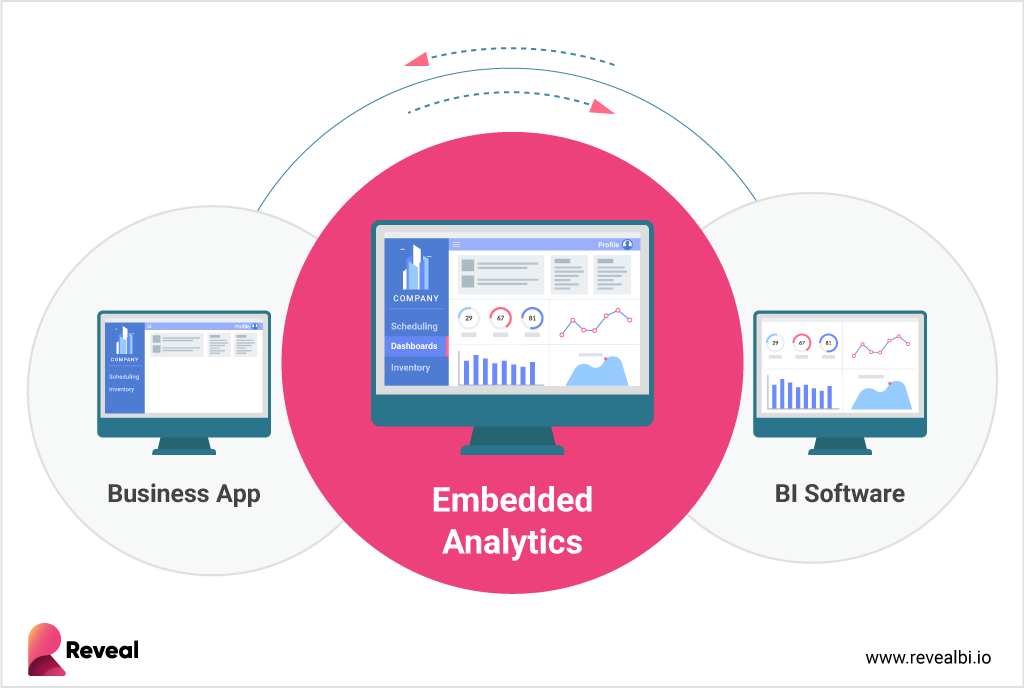
Integrated analytics refers to the practice of embedding analytics capabilities, such as dashboards, reports, data exploration, and AI-driven insights directly within business applications and workflows. Rather than routing users to separate BI tools, integrated analytics delivers contextual insight inside the software they already use. It keeps data, decisions, and workflows in one governed environment.
The term often overlaps with embedded analytics, though the emphasis may vary by vendor or architecture. Both approaches focus on delivering contextual insights inside applications rather than through standalone BI tools. To fully understand its impact, it helps to examine how integrated analytics reshapes SaaS products.
How Integrated Analytics Changes Modern SaaS Products
Modern SaaS products compete on user experience and speed of insight. Integrated analytics changes how teams design that experience. Instead of adding reports as an afterthought, product teams embed insights into core workflows. Analytics becomes part of how users complete tasks, not a separate destination.
Integrated analytics affects product performance in measurable ways:

- Reduced context switching >Users access insights without leaving the application.
- Higher product engagement Data becomes part of daily workflows rather than occasional reporting.
- Improved customer retention Products that surface relevant insights create stronger long-term dependency, as explored in customer retention with embedded analytics.
- Faster decision-making Insights appear at the point of action, not after exporting data.
This shift supports a model often described as contextual analytics, where insights align with specific user actions and permissions. When analytics integrates directly with product logic, it reflects roles, data boundaries, and workflow context. Understanding this shift requires examining how an integrated analytics platform operates at the architectural level.
How an Integrated Analytics Platform Works
An integrated analytics platform operates as a layered system that connects data, logic, and user interfaces inside an application. It does not function as a separate reporting portal. Instead, it integrates directly into the host product’s architecture. This structure allows analytics to align with application permissions, workflows, and user roles.
Core components typically include:
- Data ingestion and preparation layer Connects to databases, cloud services, and internal systems.
- API and SDK layer Exposes analytics functionality to the host application.
- Visualization engine Renders dashboards, charts, and interactive components.
- Access control framework Enforces role-based permissions and user-level restrictions.
- Multi-tenant isolation logic >Ensures each customer accesses only authorized data.
The integration layer often relies on an embedded SDK that connects analytics capabilities to the product interface. APIs manage authentication, data queries, and rendering logic. When these layers work together, the integrated analytics platform becomes part of the product’s infrastructure rather than an external add-on. Different architectural models implement these layers in different ways, which shapes flexibility, control, and security.
Integrated Analytics Architecture Models Explained
Architecture choices determine how integrated analytics functions inside a product. Different models offer varying levels of control, customization, and security. Some approaches prioritize speed of deployment. Others prioritize ownership and long-term scalability. Understanding these models helps teams evaluate trade-offs before selecting an integrated analytics platform.

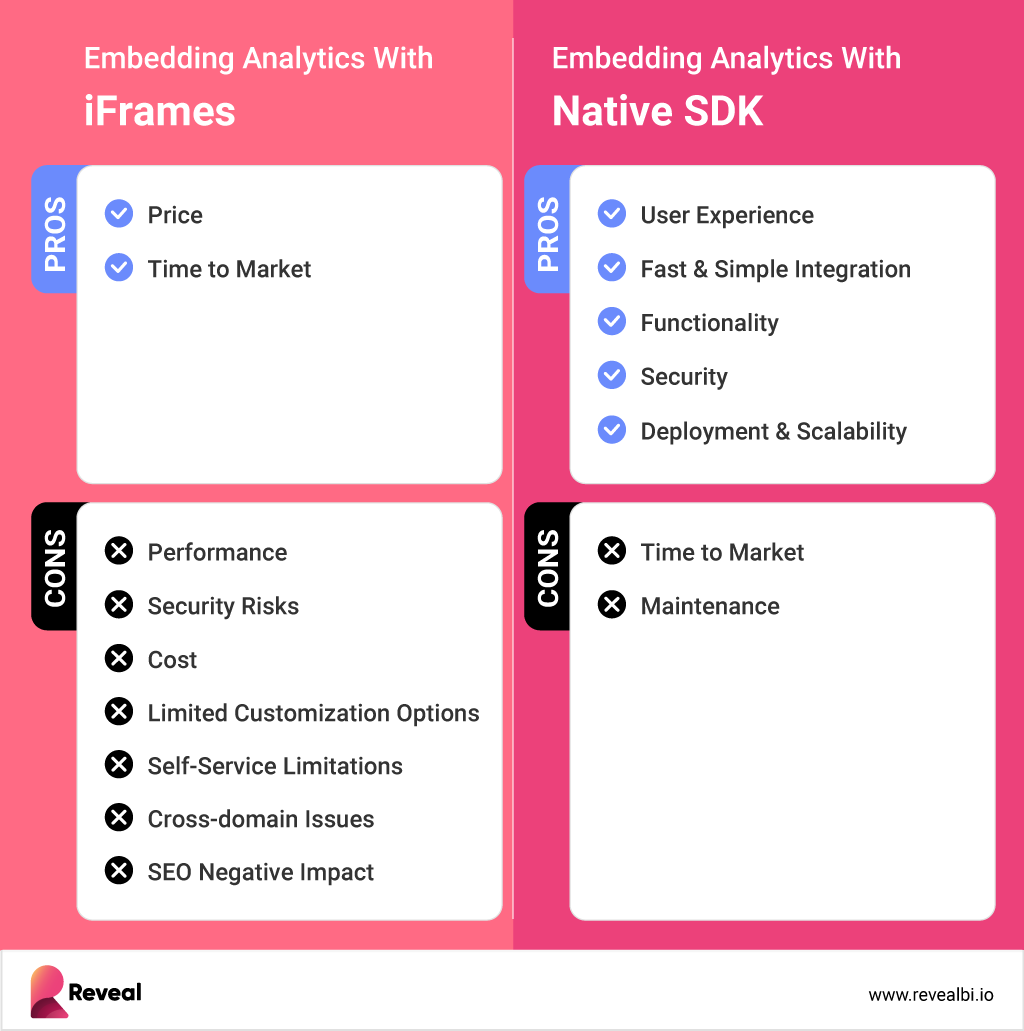
iFrame-Based Integration
iFrame-based integration loads analytics inside a framed container within the application. This model separates the analytics engine from the host product. It often enables faster initial deployment. However, customization, UI control, and security boundaries may remain limited. Teams frequently compare this approach in discussions about embedded analytics vs iFrames.
SDK-Based Embedding
SDK-based embedding integrates analytics directly into the application’s codebase. This model allows deeper control over the user interface, authentication, and data permissions. Developers can align analytics behavior with product logic and role definitions. It typically supports stronger multi-tenant enforcement and branding control.
External BI Portal Model
The external BI portal model links users to a separate reporting environment. Analytics operates outside the core application experience. This approach often mirrors traditional reporting workflows. While it may centralize reporting, it reduces contextual alignment with in-product actions.
Integrated Analytics vs Embedded Analytics vs Traditional BI
The terms integrated analytics and embedded analytics are often used interchangeably. Vendors may define them differently based on architecture or positioning. Traditional BI, however, follows a distinct model.
| Traditional BI | Embedded Analytics | Integrated Analytics |
|---|---|---|
| Separate dashboards | In-app dashboards | In-app, product-managed analytics |
| External portal access | Embedded components | Embedded with architectural integration |
| IT-managed reporting | Product-level integration | Product-native capability |
| Static or scheduled reports | Interactive dashboards | Interactive and AI-assisted insights |
| Often siloed from product workflows | Tenant-aware | Multi-tenant SaaS-ready |
Traditional BI focuses on centralized reporting environments managed by internal teams. Embedded analytics places dashboards inside applications but may vary in integration depth. Integrated analytics emphasizes architectural alignment with product logic, permissions, and tenant boundaries.
Integrated Analytics in Multi-Tenant SaaS Environments
Multi-tenant SaaS architecture introduces strict requirements for data isolation and access control. Integrated analytics must operate within these constraints.
- Tenant-level data isolation Each customer must access only authorized records and metrics.
- Role-based access enforcement Permissions must align with application-defined roles.
- Query performance isolation One tenant’s workload must not affect another’s experience.
- Secure authentication tokens Access must reflect real-time identity validation.
Key Benefits of Integrated Analytics
Integrated analytics affects both product experience and business performance. Its value extends beyond dashboard visibility.
- Improved user experience Insights appear inside workflows, reducing friction and navigation overhead.
- Increased product stickiness Embedded insights encourage regular engagement with the application.
- Faster decision-making Users act on real-time metrics without exporting or switching tools.
- Reduced developer dependency Product teams minimize ad hoc reporting requests.
- Monetization opportunities Analytics features can support premium tiers and usage-based pricing.
- Competitive differentiation Integrated analytics strengthens the perceived value of the product.
- Secure analytics in regulated industries Governance controls support compliance without compromising usability.
- AI-enhanced decision intelligence AI surfaces trends, anomalies, and guided actions
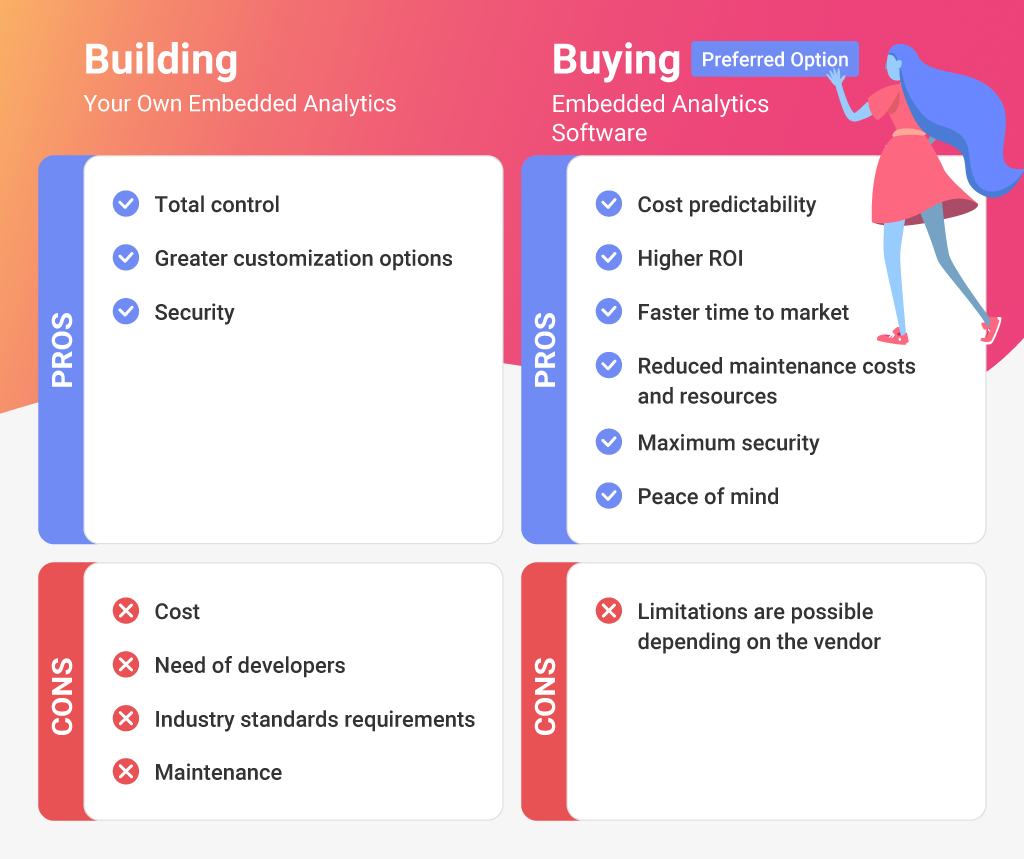
Build vs Buy: Evaluating Integrated Analytics Platforms

Organizations often face a strategic decision when implementing integrated analytics. They can build an internal solution or adopt an integrated analytics platform.
- Engineering time and opportunity cost: Internal development diverts resources.
- Ongoing maintenance and updates: Analytics infrastructure requires continuous improvements.
- Multi-tenant isolation complexity: Enforcing tenant-level boundaries is demanding.
- AI governance and compliance exposure: AI-assisted analytics increases responsibility.
- Cost predictability at scale: Infrastructure and usage growth can introduce financial volatility.
Integrated Analytics in Regulated Industries
Regulated industries impose strict requirements on data visibility and access control. Healthcare, finance, and insurance organizations operate under defined legal frameworks.
- Strict role-based access: Permissions must align with legal data boundaries.
- Data residency controls: Storage must comply with regional regulations.
- Audit trails: Systems must record user access and modifications.
- Encryption and secure authentication: Sensitive information must remain protected.
- AI guardrails: AI features must not surface unauthorized data.

Тhe AI-Native Evolution of Integrated Analytics
Artificial intelligence expands the scope of integrated analytics beyond dashboards and reports. Modern platforms now incorporate machine learning models and predictive insights.
Conversational Interfaces
Conversational capabilities allow users to query data using natural language. Platforms that support conversational analytics translate user input into structured queries.
Common Use Cases of Integrated Analytics
- SaaS customer dashboards: Real-time metrics inside portals.
- Multi-tenant analytics for ISVs: Isolated analytics experiences for clients.
- Embedded operational analytics: Performance indicators within workflows.
- Financial performance monitoring: Tracking revenue and forecasting.
- Healthcare reporting systems: Patient and operational metrics interfaces.
- Compliance tracking: Monitoring audit status and policy adherence.
- AI-powered KPI assistants: Summarizing trends and highlighting anomalies.
Integrated Analytics with Reveal
Reveal delivers an integrated analytics platform designed for modern SaaS applications. Its architecture supports deep product integration through:
- SDK-based embedding Developers integrate analytics directly into application code.
- AI-native analytics layer Built-in AI analytics enables conversational queries.
- Role-based governance Access controls enforce tenant and user-level boundaries.
- Multi-tenant architecture Isolation logic protects customer data.
- White-label customization Configurable white-label analytics supports branding.
Compliance and governance remain central design principles. Integrated analytics security protects sensitive data.