



Stay up to date with Reveal
Reveal business intelligence blog gives you the latest embedded analytics trends, how-tos, best practices, and product news.

FEATURED
Introducing Reveal AI: The AI-Native Embedded Analytics Layer for Enterprise and SaaS Applications
Users expect analytics to behave like the rest of modern software: interactive, immediate, and conversational. Reveal AI addresses this shift by adding conversational analytics and AI-generated insights directly inside enterprise and SaaS applications. Built on Reveal’s SDK-first embedded analytics architecture, it allows users to ask questions in natural language, receive contextual explanations, and detect anomalies. At the same time, organizations keep full control over governance, deployment, and AI cost management.
Continue reading...test
What Is Embedded Analytics? Embedded analytics is the practice of building analytics, dashboards, reports, and AI-powered insights, directly into a software product so end users can analyze data without leaving the application. Unlike standalone BI tools, embedded analytics is part of the product experience, not a separate destination. In practice, that looks like this: A […]
Continue reading...
Vibe Coding Analytics: Can You Really Build Instead of Buy?
Vibe coding analytics is changing how SaaS teams approach build vs buy decisions. AI makes it easy to generate dashboards, test ideas, and move fast early. But speed at the start does not translate to success in production. Customer-facing analytics requires governance, security, and cost control—areas where AI alone falls short. As AI raises expectations from dashboards to embedded intelligence, teams must decide to build and own the complexity, or adopt a platform designed for production analytics.
Continue reading...
What Is an Analytics SDK? Definition, Examples, and How to Choose the Right One
An analytics SDK allows SaaS teams to embed dashboards, reporting, and data exploration directly into their product without building everything from scratch. As products scale across teams, frameworks, and regions, analytics becomes more than a feature; it becomes infrastructure. At that point, flexibility, performance, and control are no longer optional.
Many solutions appear similar early on but introduce constraints that slow development or limit architecture choices as products grow. Modern analytics platforms must support multiple frameworks, AI-driven interactions, and scalable deployment, without forcing teams to adapt their product to the tool.
Continue reading...
SLM vs. LLM: Which AI Model is Right for Embedded Analytics?
Modern embedded analytics layers is shifting from static dashboards to AI-driven interaction inside Saas products. As teams embed conversational capabilities into their analytics, they must decide between small and large language models. The SLM vs. LLM choice affects latency, token costs, governance, and deployment flexibility. Small models often handle frequent analytics queries efficiently, while large models support deeper reasoning. Many organizations adopt hybrid architectures that combine both. Platforms like Reveal allow teams to add AI to their analytics layer without sacrificing cost predictability, governance, or deployment flexibility.
Continue reading...
AI Token Costs In Embedded Analytics: Why They’re Becoming a CIO Problem
AI token cost is now a line item in the CIO’s budget, especially for SaaS teams shipping AI-powered embedded analytics. Every natural language query, generated dashboard, and automated insight inside your embedded analytics layer burns tokens from large language models. Across a multi-tenant SaaS platform with thousands of users, that adds up fast. Controlling AI token consumption requires real governance: guardrails, model flexibility, and usage monitoring. Reveal built these controls into its AI-powered embedded analytics from day one, so your team can scale AI analytics without watching costs spiral.
Continue reading...test post
TEST TEST
Continue reading...
The Hidden Cost of Slow BI and Dashboards in SaaS
Slow BI and dashboards reduce Saas adoption, retention, and revenue. Users explore less, export more, and stop treating analytics as core to their workflow. The impact spreads from engagement metrics to expansion revenue and churn risk. High-performance embedded analytics requires deliberate architecture: intelligent caching, workload separation, and concurrency planning. Teams that design for performance early protect user trust and turn analytics into a competitive advantage.
Continue reading...
How to build AI-Generated Dashboards from User-defined Queries
AI-generated dashboards promise faster insight, but most implementations fail in real products. The issue is not model quality. It is architecture.
Production-ready AI-generated dashboards must operate inside the analytics lifecycle, not outside it. That means intent detection rather than query generation, metadata rather than SQL, and reuse rather than constant creation. When AI respects security, business language, and existing workflows, dashboards become durable product assets.
This approach shifts analytics from one-off answers to embedded decision support that scales across users, tenants, and use cases.
Continue reading...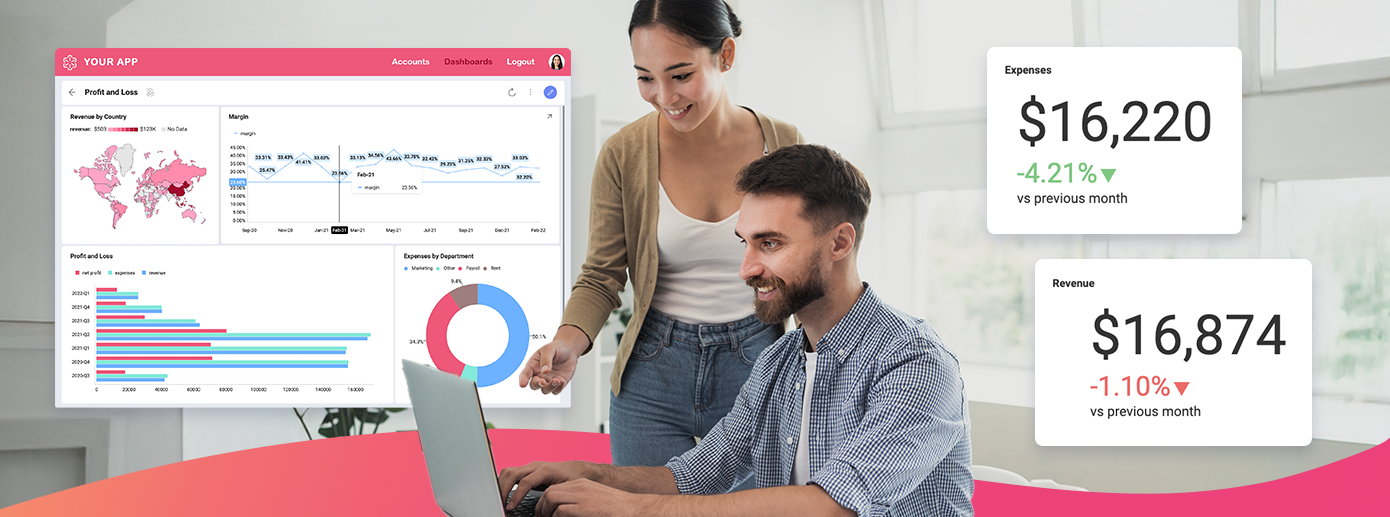
How Product Leaders Drive Embedded Analytics Adoption
Many SaaS and ISV platforms struggle to help non-technical users adopt their product’s analytics capabilities. This affects product value, retention, and long-term revenue. Strong embedded analytics adoption depends on ease of use, contextual analytics, and decision-level context. Leaders who align analytics with real customer needs, workflows, and outcomes see stronger analytics adoption and higher engagement. Reveal supports this by helping product teams deliver analytics uses can trust and use.
Continue reading...


